Riviera travel time study: the same four-day holiday, timed from six bases
If you explore the French Riviera without a car, where should you stay to spend the least time getting around? Plenty of guides say Nice is convenient. We timed the same Riviera holiday from six different bases.
Main resultTime spent travelling over the same four-day programme, by base
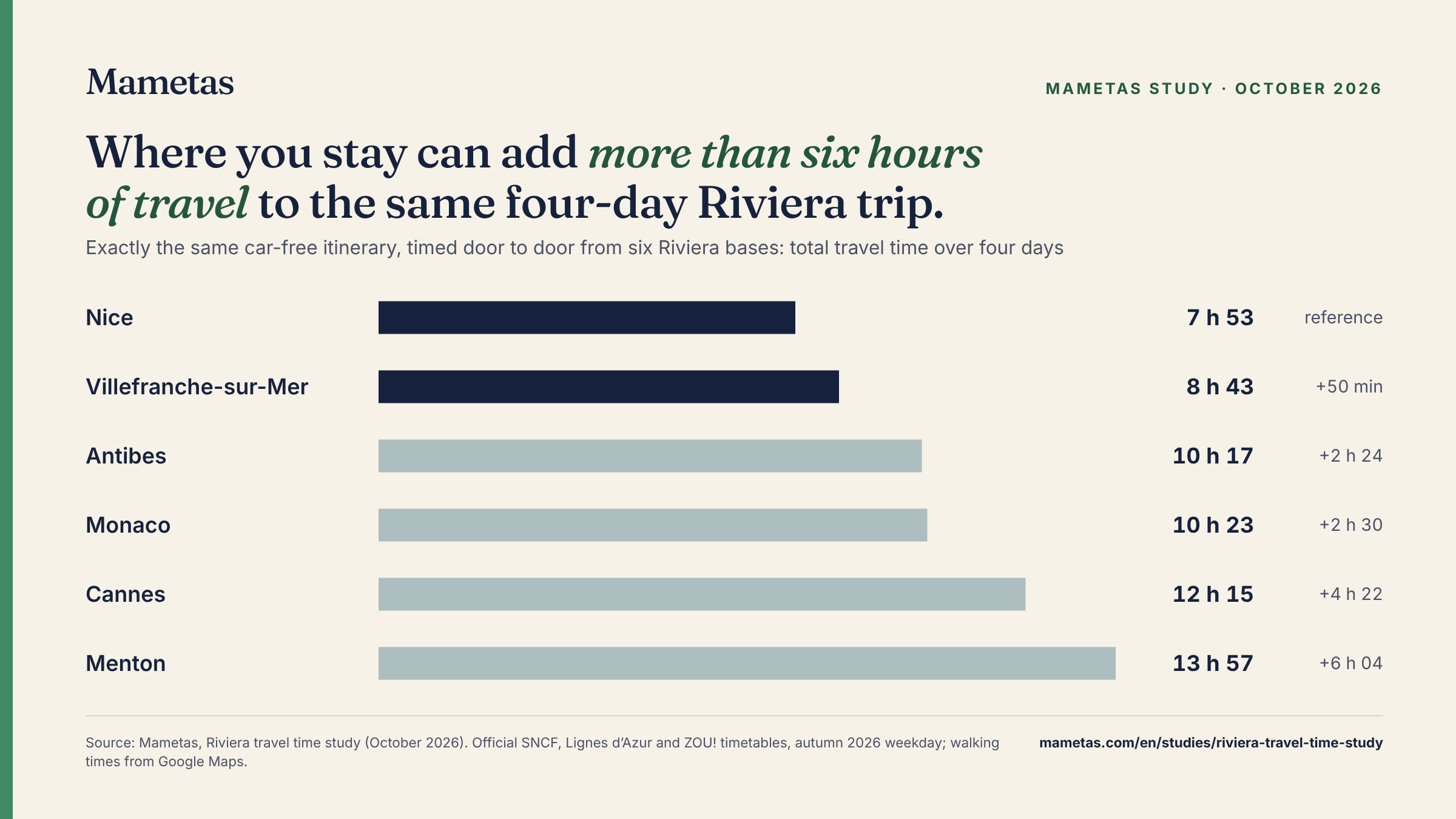
On the same four-day first-timer itinerary, the choice of base changed total travel time by just over six hours. Door to door: walking, waiting, trains, trams, buses and connections included. Download the chart (PNG).
The test at a glance
- Who? A first-time visitor staying in one Riviera base and travelling without a car.
- How long? Four full sightseeing days within an average 5.5-night Riviera stay.
- Why these places? Major Riviera visitor destinations supported by official tourism data, grouped into geographically natural day trips.
- What do we compare? The same four-day programme, run from six possible bases.
- What counts? Walking, waiting, trains, trams, buses and connections, door to door.
- The question: how much of the same holiday does the choice of base make you spend travelling?
The programme
| Day | Places visited |
|---|---|
| Day 1 | Nice |
| Day 2 | Èze village, then Monaco |
| Day 3 | Antibes, then Cannes |
| Day 4 | Villefranche-sur-Mer, then Cap-Ferrat (Villa Ephrussi de Rothschild) |
Each day starts from the centre of the base in the morning, moves to the second place at lunchtime and returns in the late afternoon.
What this test measures, and what it does not
- It measures the time spent getting from place to place by public transport, on official timetables, for one representative programme.
- It does not compare public transport with a car. Driving, traffic and parking would be a different study.
- It does not time every attraction once you arrive. For towns, we measured the journey to one central tourist point; for standalone sights such as Èze village and the Villa Ephrussi, to the sight itself.
The result
On the same four-day first-timer itinerary, the choice of base changed total travel time by just over six hours.
| Base | Time spent travelling over the four days | Difference with Nice |
|---|---|---|
| Nice | 7 h 53 | reference |
| Villefranche-sur-Mer | 8 h 43 | +50 min |
| Antibes | 10 h 17 | +2 h 24 |
| Monaco | 10 h 23 | +2 h 30 |
| Cannes | 12 h 15 | +4 h 22 |
| Menton | 13 h 57 | +6 h 04 |
These figures are valid for this representative first-timer programme. They are not a universal ranking of Riviera bases: a visitor with different plans will see different numbers.
- Nice and Villefranche-sur-Mer were the two most efficient bases for this programme, 50 minutes apart over four days.
- Antibes and Monaco sit in the middle, about 2½ hours behind Nice.
- Cannes has a station a few minutes from the Croisette, yet over the four days it added 4 h 22 of travel compared with Nice.
- Menton added just over six hours, about 1½ hours a day.
Why the gaps appear
Four things explain most of the difference: where the base sits on the coast, whether it is itself a place you want to visit, missed connections and the walk to the station.
Position on the line. Our six bases line up along one coastal railway, from Cannes in the west to Menton in the east, with Nice in the middle. From either end, every trip to the other half of the coast passes through Nice. From Menton, the Antibes and Cannes day alone takes 4 h 20 of travel; from Nice, 2 h 35.
A base that is also a destination. When a place in the programme is your base, that visit costs no travel. Staying in Nice saves the whole of Day 1; Villefranche saves the morning of Day 4; Antibes and Cannes each save half of Day 3. Menton is not in the programme, so it never gets that advantage.
A six-minute miss can cost 75 minutes. From Cannes, the 9:13 train reaches Èze station at 10:10. The bus up to Èze village left at 10:04, and the next one leaves at 11:25. Day 2 costs 5 h 35 of travel from Cannes, against 3 h 17 from Nice.
The walk to the station counts. Menton’s old town is 17 minutes on foot from its station, so every day out starts and ends with that walk. In Nice, the tram brings Place Masséna within 12 minutes of the station. In Villefranche, the harbour square is 9 minutes away on foot.
Does the result hold beyond this itinerary?
Yes: a wider test with nine separate day trips per base gives the same order, from Nice to Menton.
A four-day programme is a choice, and a different choice could favour different bases. So we ran a second, broader test. We took ten places: the six bases plus Grasse, Èze village, Cap-Ferrat and Saint-Paul-de-Vence. From each base, we timed a separate return trip to each of the other nine places, with the same rules: door to door, walking and waiting included.
Nobody is expected to take all nine trips. The point is to see how easily each base reaches the whole coast.
| Base | Average travel time per day trip (9 separate trips) | Rank in the benchmark | Rank in the four-day programme |
|---|---|---|---|
| Nice | 2 h 18 | 1 | 1 |
| Villefranche-sur-Mer | 2 h 19 | 2 | 2 |
| Antibes | 2 h 34 | 3 | 3 |
| Monaco | 2 h 40 | 4 | 4 |
| Cannes | 2 h 55 | 5 | 5 |
| Menton | 3 h 18 | 6 | 6 |
The order is identical in both tests. In the benchmark, Nice and Villefranche-sur-Mer are practically tied, one minute apart per trip, and Menton needs about an hour more per trip than either.
Methodology
We built the test from official tourism data, then timed every journey on operators’ timetables.
Why this visitor, this length, these places
- The visitor. The Côte d’Azur welcomes 12.5 million tourists a year. First-time visitors account for 39% of stays: 28% of stays by French visitors and 50% of stays by foreign visitors. We modelled a first-time visitor who stays in one place and travels without a car.
- The length. Visitors stay 5.5 nights on average. We modelled four full sightseeing days, leaving the rest of the stay for arrival, departure and time in the base itself.
- The places. The programme is built around destinations that rank among the Côte d’Azur’s most visited attractions in official 2024 figures: Monaco’s Oceanographic Museum (661,749 visitors), Èze’s Jardin exotique (575,325), the Villa Ephrussi de Rothschild in Cap-Ferrat (220,846), the Picasso Museum in Antibes (183,238), and Nice, home to several other top-ranked sites. Cannes is represented by its centre; its most visited site, the Îles de Lérins, needs a boat that we did not time.
- The day groupings. Pairing places into days is our editorial choice, based on geography: Èze and Monaco are neighbours to the east, Antibes and Cannes to the west, Villefranche and Cap-Ferrat share the same bay. No public data records which places visitors combine in one day.
- The bases. The Nice, Antibes and Cannes areas account for 78.5% of tourist stays on the Côte d’Azur. Menton and Monaco are the other two main coastal hubs. Villefranche-sur-Mer stands for the small towns of the Nice coastline, which together host 7.5% of stays.
How we timed it
Starting points. For towns, we timed the journey to a fixed central tourist anchor rather than individual attractions. The aim is to compare access to the destination, not every movement once there. For standalone sights such as Èze village and the Villa Ephrussi, we used the sight itself:
| Place | Tourist anchor | Station or stop | Access time |
|---|---|---|---|
| Nice | Place Masséna | Nice-Ville station | 12 min (tram L1 and walk) |
| Villefranche-sur-Mer | Place Amélie-Pollonnais | Villefranche station | 9 min on foot |
| Antibes | Place Nationale | Antibes station | 12 min on foot |
| Monaco | Place du Casino | Monaco-Monte-Carlo station | 10 min on foot |
| Cannes | Palais des Festivals | Cannes station | 7 min on foot |
| Menton | Place aux Herbes | Menton station | 17 min on foot |
| Èze village | Place du Planet | Èze Village bus stop | 9 min on foot |
| Cap-Ferrat | Villa Ephrussi de Rothschild | Passable / Rothschild bus stop | 6 min on foot |
Daily timing. The visitor leaves the base in time to be at the station at 9:00 and takes the first useful departure. At 13:00 they head for the second place of the day, and at 17:00 they head home. Every minute from the tourist anchor to the next tourist anchor counts: walking, waiting, trains, trams, buses and connections, with at least 3 minutes for each change.
Routes. We kept the fastest public-transport route. From Nice, Èze village is reached by tram and the ZOU! 602 coach. The other trips use the train, with bus 83 up to Èze village and bus 15 to Cap-Ferrat.
Sources. Train, tram, bus and coach times come only from the operators: SNCF (TER Sud), Lignes d’Azur and the Région Sud ZOU! network, on autumn 2026 weekday timetables. Google Maps was used only for walking times, in walking mode, collected on 16 October 2026.
Limitations
This is an autumn 2026 timetable test of one representative programme. We will review the results when the summer 2027 timetables are published.
- The Nice day. Day 1 is spent in Nice, one of the most visited destinations, and costs no travel to visitors staying there. Without that day, Villefranche-sur-Mer moves ahead of Nice by about 10 minutes, and the rest of the ranking does not change.
- One programme. Another itinerary would give other numbers, and the study does not compare public transport with a car. The nine-trip benchmark shows that the order holds beyond this programme, but it cannot cover every possible plan.
- Length of stay. The 5.5-night average covers all types of accommodation. Hotel guests stay 2.2 nights on average. Our test describes a longer stay, made to discover the coast.
- Where you stay within a town. Each base is measured from one central square. In Nice, starting from Place Garibaldi instead of Place Masséna adds about 4 minutes to each trip to the station.
- Season. Autumn weekday timetables. Train geography is stable, but frequencies, some bus services and the boats to Saint-Tropez and the Îles de Lérins change in summer.
- Evening trains. SNCF night works close the line between Nice and Ventimiglia from 22:00 to 6:00, Sunday to Thursday nights, until 11 December 2026. Our returns start at 17:00 and are not affected.
- Monaco’s station. Monaco-Monte-Carlo station is largely underground. Walking times stop at its street entrance and do not count the corridors to the platforms. As for every town, we measured to one central point, Place du Casino, not to individual attractions such as the Oceanographic Museum.
- Real-world delays. Timetables assume trains and buses run on time. Traffic, strikes and works are not modelled.
The data
All times are in minutes, from tourist anchor to tourist anchor, walking, waiting and connections included.
The four-day programme, day by day
| Base | Day 1: Nice | Day 2: Èze + Monaco | Day 3: Antibes + Cannes | Day 4: Villefranche + Cap-Ferrat | Total |
|---|---|---|---|---|---|
| Nice | 0 | 197 | 155 | 121 | 473 (7 h 53) |
| Villefranche-sur-Mer | 60 | 206 | 179 | 78 | 523 (8 h 43) |
| Antibes | 106 | 252 | 79 | 180 | 617 (10 h 17) |
| Monaco | 99 | 169 | 220 | 135 | 623 (10 h 23) |
| Cannes | 116 | 335 | 79 | 205 | 735 (12 h 15) |
| Menton | 162 | 238 | 260 | 177 | 837 (13 h 57) |
The three lunchtime transfers are the same for every base:
| Transfer | Minutes | Route |
|---|---|---|
| Èze village → Monaco | 67 | Bus 83 at 13:20 to Èze station, train at 13:41, Monaco 13:48, walk to Place du Casino |
| Antibes → Cannes | 44 | Walk to Antibes station, train at 13:12, Cannes 13:25, walk to the Palais des Festivals |
| Villefranche → Cap-Ferrat | 33 | Train at 13:02 to Beaulieu, bus 15 at 13:12, Passable / Rothschild 13:18, walk to the Villa Ephrussi |
The nine-trip benchmark: round-trip time per destination
| Base | Nice | Villefranche | Antibes | Monaco | Cannes | Menton | Grasse | Èze village | Cap-Ferrat | Saint-Paul | Average per trip |
|---|---|---|---|---|---|---|---|---|---|---|---|
| Nice | · | 61 | 110 | 99 | 116 | 154 | 261 | 160 | 102 | 182 | 138 |
| Villefranche-sur-Mer | 60 | · | 122 | 84 | 143 | 139 | 265 | 169 | 87 | 186 | 139 |
| Antibes | 106 | 120 | · | 159 | 63 | 211 | 175 | 215 | 164 | 170 | 154 |
| Monaco | 99 | 84 | 162 | · | 181 | 102 | 285 | 180 | 107 | 236 | 160 |
| Cannes | 116 | 145 | 75 | 181 | · | 225 | 151 | 299 | 183 | 203 | 175 |
| Menton | 162 | 117 | 214 | 101 | 224 | · | 316 | 223 | 155 | 267 | 198 |
The published tables are available as a spreadsheet: download the data (XLSX). The full leg-by-leg dataset, with departure and arrival times, train and bus numbers, walking times and the source of each timetable, is available on request through our press page.
Sources
Timetables were consulted between 15 and 16 October 2026.
- Tourism data: Côte d’Azur Tourism Observatory, key figures, 2025 edition (2024 data): 12.5 million tourists, 5.5 nights average stay, share of first-time visitors, stays by area and attendance of the main visitor attractions.
- Trains: SNCF Connect timetable pages for each pair of stations, cross-checked with the TER Sud timetable sheet n°04 Grasse – Cannes – Nice – Vintimille, valid 14 December 2025 to 12 December 2026.
- Night works: TER Sud, works between Nice and Ventimiglia.
- Nice tram and buses 15, 82, 83: stop-by-stop timetables on the Lignes d’Azur website, with the line sheets for bus 15 and bus 83, valid from 28 September 2026.
- Coach 602 Nice – Èze – Monaco: ZOU! timetable sheet, valid from 28 September 2026.
- Coach 655 Cagnes – Saint-Paul – Vence (benchmark only): ZOU! timetable sheet, July 2025 edition, listed as current on the ZOU! Alpes-Maritimes index.
- Walking times: Google Maps, walking mode, 16 October 2026.
Downloads. Data (XLSX) · Chart (PNG, 2400 × 1350). Press enquiries: hello@mametas.com · press page.
What this means for your trip
If you plan to explore without a car, where you stay decides how much of your holiday goes on getting around.
- Planning a mix of east and west, like this programme? Nice and Villefranche-sur-Mer kept travel lowest. In Nice, stay within a few minutes of a tram stop or the station.
- Mostly the west: Antibes, Cannes, Grasse? Antibes and Cannes reach those places faster than Nice.
- Mostly Monaco and the Italian border? Monaco is well placed for that end of the coast.
The traveller’s version of this study, with the areas to book in each town, is on our page where to stay on the French Riviera without a car. Riviera Fit matches your base to the places you actually plan to visit, then Hotel Fit finds a hotel close to the station or tram stop that makes those days easy.